
From Bean to Bar: How Artisanal Chocolate is Made Using the Bean-to-Bar Method
Artisanally produced chocolate, often referred to as "bean-to-bar," represents a process where the maker oversees all stages of the chocolate's creation – from the raw cocoa bean to the final bar. Unlike industrial production, everything takes place in small batches with an emphasis on quality and detail. Each maker chooses their own procedures and recipes, meaning the resulting chocolates have a unique flavor profile. Producing bean-to-bar chocolate is demanding in terms of both time and manual labor – making a single bar often takes a week or longer. In this article, we will take a step-by-step look at how such artisanal chocolate is created and point out the differences compared to mass industrial production.
Selection of Quality Cocoa Beans
It all starts with a careful selection of cocoa beans. Artisanal makers often buy beans directly from farmers or specialized suppliers. They are interested in the variety, origin, and the way the beans are processed after harvest – especially proper fermentation and drying. Although cocoa beans are traded as a commodity on the world market, small-scale producers prefer direct trade and traceability over the lowest price. They often choose aromatic varieties of cacao trees grown on small plantations in Latin America, the Caribbean, Africa, or Asia, which offer a richer flavor spectrum.
Well-selected beans are the foundation of success. Even the best manufacturing process cannot save chocolate made from inferior beans.
Fermentation and Drying of Cocoa Beans
Once the cacao pods are harvested and the pulp is removed, fermentation begins. Without it, cocoa would lack its typical chocolate aroma. The beans (coated in residues of white, sweet pulp) are poured into wooden boxes or baskets and covered with banana leaves. Fermentation usually lasts 3 to 7 days depending on the variety. Inside the pile of beans, the temperature rises up to 50°C, and three phases of fermentation gradually take place: alcoholic, lactic, and acetic. During fermentation, the germination of the seeds stops, and the beans completely change their color and taste. Thanks to fermentation, the beans lose the pulp residue and develop a unique aroma, which is the basis for the final flavor of the chocolate.
After fermentation comes drying. Farmers spread the fermented beans most often in the sun (for example, on mats or drying tables) or in dryers with warm air. Drying generally takes several days until the moisture content of the beans drops to a safe level of around 6-7%. This step is crucial – it stops residual fermentation and, most importantly, prevents the growth of mold during further storage and transport. Well-dried beans have a brown color, an intense cocoa scent, and are ready for their journey from the plantation to the chocolate factory. Before being packed into jute bags, they are often manually sorted and cleaned again to remove impurities and bad beans.
Roasting Cocoa Beans
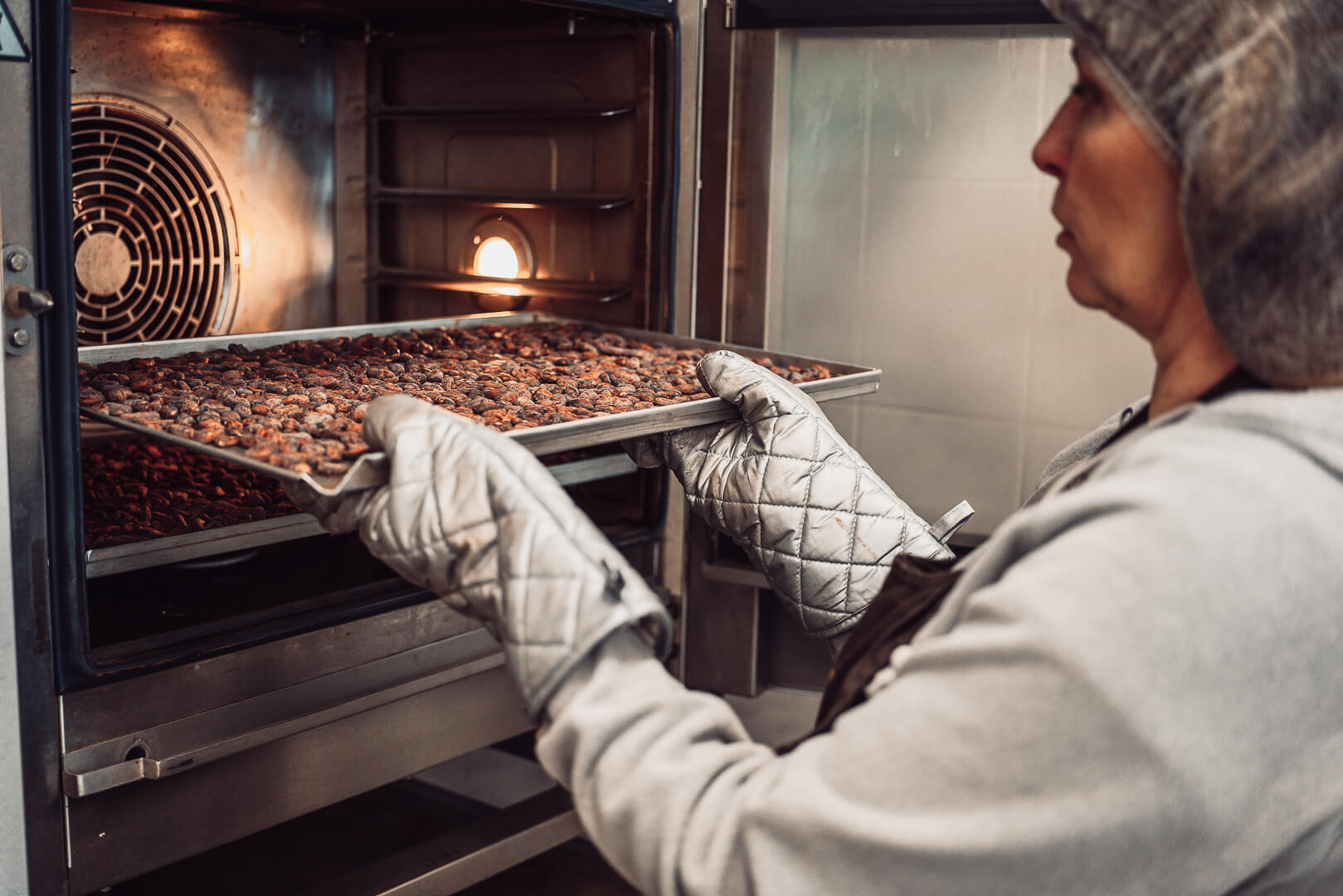
The dried cocoa beans travel to the chocolate makers, where the beans are roasted after further manual selection. Roasting is key to developing the final aroma of the chocolate – during this process, desirable flavors are highlighted, and the beans acquire a darker color. The temperature and duration of roasting depend on the approach of each maker. Artisanal makers always opt for gentler roasting – preferring a longer time at a lower temperature over scorching the beans. Every new batch deserves an individual approach, and its roasting profile is carefully tested.
Some makers roast the beans in a rotating drum roaster (like coffee is roasted), while others use an electric oven or a convection oven, spreading the cocoa beans in a single layer on perforated trays.
Crushing and Winnowing
Roasted beans need to be stripped of their thin husks, which do not belong in chocolate. First, the roasted beans are allowed to cool, followed by crushing and winnowing. In this step, the beans are coarsely crushed, creating a mixture of cocoa bean pieces (known as cocoa nibs) and crushed husks. Using air (suction), the light husks are separated from the heavier cocoa bean kernels. This process is called winnowing and ensures that only clean cocoa nibs move on to the next phase. Artisanal makers often build their own equipment for winnowing, adapted for small volumes.
Grinding Cocoa Beans
Now comes one of the most important parts of the entire process: grinding the cocoa nibs into a liquid chocolate mass. In artisanal workshops, stone mills called melangeurs are used – devices with granite wheels that rotate and crush the cocoa pieces. The cocoa pieces are ground in the mill for long hours, usually 72 hours or more continuously. Through friction and heat, cocoa butter is released from the bean pieces until a cocoa mass is formed. Through grinding, the cocoa pieces are continuously refined to a size of about 20–25 micrometers. This is the threshold where the human tongue no longer perceives individual particles, and you feel the chocolate melting on your tongue.
The speed of the stones, their size, pressure, temperature during grinding, and the total duration of grinding – all of this affects the final quality of the chocolate. Time plays an extraordinary role. While industrial factories grind cocoa mass for a short time, in artisanal production, slow stone grinding can take up to 72 hours depending on the recipe. Each maker chooses whether to add sugar (or other ingredients) right at the start of grinding or after a certain period.
Conching the Chocolate
Conching is a special phase of chocolate processing where the mass is mixed and aerated. In artisanal production, conching often takes place simultaneously with grinding in the melangeur – the long mixing process aerates the chocolate at the same time. The goal of conching is to achieve a smooth texture and fine-tune the chocolate's flavor. Continuous stirring releases volatile aromatic compounds from the mass, and undesirable acidic notes gradually disappear. For top-tier chocolates, conching (whether in the melangeur or a separate conching machine) can last up to 72 hours. The result is a silkily smooth chocolate with a rich aroma.
Each maker approaches conching slightly differently. Some artisanal makers do not use a conching machine at all and combine grinding and conching in the melangeur. Others conch separately, but only for the strictly necessary amount of time. In industrial factories, on the other hand, conching is often intense and at high temperatures; however, this tends to unify and flatten the chocolate's flavor. Artisanal chocolate, thanks to more sensitive conching, preserves the nuances of flavor specific to the given beans and region of origin.
During conching (or at its end), the remaining ingredients are mixed into the chocolate mass depending on the type of chocolate. For dark chocolates, this is usually just cane sugar and a bit of cocoa butter; for milk chocolates, milk powder is added. Some makers also add real vanilla for flavoring, while others avoid it to let the pure taste of cocoa stand out. Importantly, artisanal makers do not use cheap substitutes – real bean-to-bar chocolate contains no palm fat, artificial flavorings, or soy lecithin. If it is necessary to adjust the viscosity or gloss of chocolate with a higher sugar content, a small amount of extra cocoa butter is added instead. The resulting mixture is pure chocolate without compromises.
After grinding and conching are finished, the cocoa mass is often allowed to "rest" for some time. Artisanal makers have found that allowing the finished chocolate mass to mature before further processing deepens and rounds out its flavor. Only then do the final adjustments and packaging take place.
Tempering Chocolate
For chocolate to be glossy, to have a snap when broken, and to not melt at room temperature, it must undergo a process called tempering. Tempering consists of controlled heating and cooling of the cocoa mass so that all the cocoa butter contained within it forms a stable crystalline structure. Cocoa butter can crystallize in several forms, of which only one (Form V) gives the chocolate the correct snap, hardness, and gloss. During tempering, the chocolate is first heated (usually to approx. 45–50°C), melting all the butter crystals. Subsequently, the mass is quickly cooled to a lower temperature (around 27–29°C) and finally heated slightly again to the working temperature (approx. 30–32°C). This creates the desired crystal structure. If tempering were skipped, the resulting chocolate would be soft, dull, and flexible rather than snappy when broken. A correctly tempered bar, on the other hand, shines beautifully, snaps loudly when broken, and does not melt instantly in your hand.
In small-scale production, tempering is performed either manually or using tempering machines. Manual tempering usually involves the "tabliering" method – pouring hot chocolate onto a marble slab and cooling it quickly by spreading it, or "seeding" (adding stable crystals from already tempered chocolate). Manual tempering depends on experience and precision, but when done correctly, it matches machine tempering. Most artisanal chocolate factories today use tempering machines that control the temperature curve. Tempered chocolate goes directly from the machine into prepared molds.
Molding and Cooling
The final step of production is pouring the chocolate into molds, allowing it to solidify, and packaging. Tempered chocolate is dispensed into pre-prepared molds – most often plastic, polycarbonate, or silicone, which take the shape of bars or, for example, lollipops. In the workshop, the molds are shaken or vibrated after being filled with chocolate to release air bubbles and level the surface of the bar. Subsequently, the chocolates are left to solidify in the molds – either at room temperature or in a cooling box.
Once the chocolate has solidified in the molds (the color becomes matte and the molds feel slightly warm to the touch as the chocolate crystallizes), the bars are popped out of the molds. Properly tempered chocolate falls out of the mold very easily and has a beautiful gloss. The final step is packaging – and even this is often manual work for bean-to-bar producers with an emphasis on aesthetics. The bars are wrapped in protective foil or paper and then into designer packaging, often featuring information about the origin of the beans and the chocolate's story.
Artisanal vs. Industrial Chocolate Production
The bean-to-bar approach differs in many ways from mass industrial production. Here is an overview of the main differences:
-
Cocoa Origin and Varieties: Large factories predominantly buy cheap cocoa beans from West Africa – often hybrid varieties bred for high yield but less aromatic (the cocoa equivalent of Robusta in coffee). Artisanal makers, conversely, source cocoa from smaller farms in Central and South America, the Caribbean, Africa, or Asia, often from noble varieties with rich flavor (analogous to Arabica coffee). Quality of the raw material, an original flavor profile, and ethical origin are more important to them than a low price.
-
Fairness and Transparency: In industry, the cocoa trade takes place through exchanges and wholesalers. Farmers thus receive only a fraction of the final price and often have no idea which product their beans end up in. Artisanal chocolate factories often practice Direct Trade or work with suppliers who pride themselves on fairness. Makers track how the beans were fermented and dried, and often participate in programs to support growers (education, better technology, fair wages). The resulting artisanal chocolate is thus not only tastier but also more ethical.
-
Processing of Beans: Industrial factories focus on speed and efficiency – beans are roasted quickly at high temperatures, coarsely crushed, and ground rapidly by machines. In contrast, artisanal production is carried out in a slow, gentle manner. Beans are roasted at lower temperatures. They are then crushed and slowly ground in a melangeur for hours or even days. Any bitterness or acidity (if the beans have any) gradually fades away during long grinding and conching.
-
Chocolate Composition: The main goal of industry is uniformity and low price. Therefore, cheap ingredients are combined when mixing the cocoa mass: cocoa powder, minimal cocoa butter (the valuable part is preferred for other uses or sold), often hydrogenated vegetable fat (typically palm) instead, plus sugar, emulsifier (lecithin), and milk powder for milk chocolate. These ingredients are precisely dosed and combined in a conching machine so that the resulting chocolate always tastes the same. Artisanal chocolate, by contrast, contains only the essentials: for dark, usually just cocoa beans and sugar; for milk, milk is added as well. The cocoa butter contained in the beans remains in the chocolate, and no foreign fats or artificial additives are added. They mostly use high-quality cane sugar. The result is pure chocolate without substitutes, where the taste of cocoa stands out.
-
Flavor and Diversity: Industrially produced chocolates are intentionally uniform in taste and rather bland. The goal is for every piece to taste exactly like the previous one – nothing surprising, no disruptive notes, just pleasant sweetness. Even high-percentage dark chocolates from large brands tend to be flat and lack character because they are mixed from semi-finished products. This makes it easy to eat an entire bar in one sitting, but the actual flavor experience is minimal. Artisanal chocolate, on the other hand, offers a wide palette of flavors. Every batch can be an original – sometimes fruit notes stand out, other times nutty or floral, depending on the origin of the beans and the process. Tasting bean-to-bar bars is similar to wine or specialty coffee tasting. You can discover layers of flavors and aromas, comparing different origins and harvests. Just a few squares of quality chocolate provide an intense experience.
-
Tempering and Aging Process: In tempering, procedures converge – both industry and small-scale production use tempering machines to guarantee stable crystallization of cocoa butter. The difference is that some small producers temper manually (for economic reasons) and rely on skill. In artisanal production, the aforementioned aging of chocolate is also applied – it is left to rest before tempering. Factories mostly skip this delay to speed up production.
-
Quantity and Manual Work: Industrial enterprises churn out enormous volumes of chocolate fully automatically – large lines produce thousands of bars per hour, and packaging machines wrap them in a few seconds. In contrast, artisanal production is limited by the capacity of a small manufactory. Many tasks are done by hand: sorting beans, grinding (supervising the melangeur), pouring into molds, popping out bars, and careful packaging. With all this, the price of artisanal chocolate increases – it is more expensive than supermarket chocolate because it includes first-class raw materials, fair compensation for farmers, and significantly more human labor. For the customer, however, it represents something special – a pleasure that a common bar for a few crowns cannot offer.
The result of artisanal production is chocolate bars with distinct flavor notes – they are fruity, floral, spicy, or otherwise complex, and every bite reveals a piece of the story about the beans' origin. Bean-to-bar chocolate thus awakens the senses and allows us to taste cocoa in its most natural and delicious form. Enjoy the difference – just let a square melt on your tongue and dive into the rich flavor of real chocolate. The icing on the cake is the knowledge that you are enjoying a product created with artisanal care and respect for the ingredients and the people involved.