

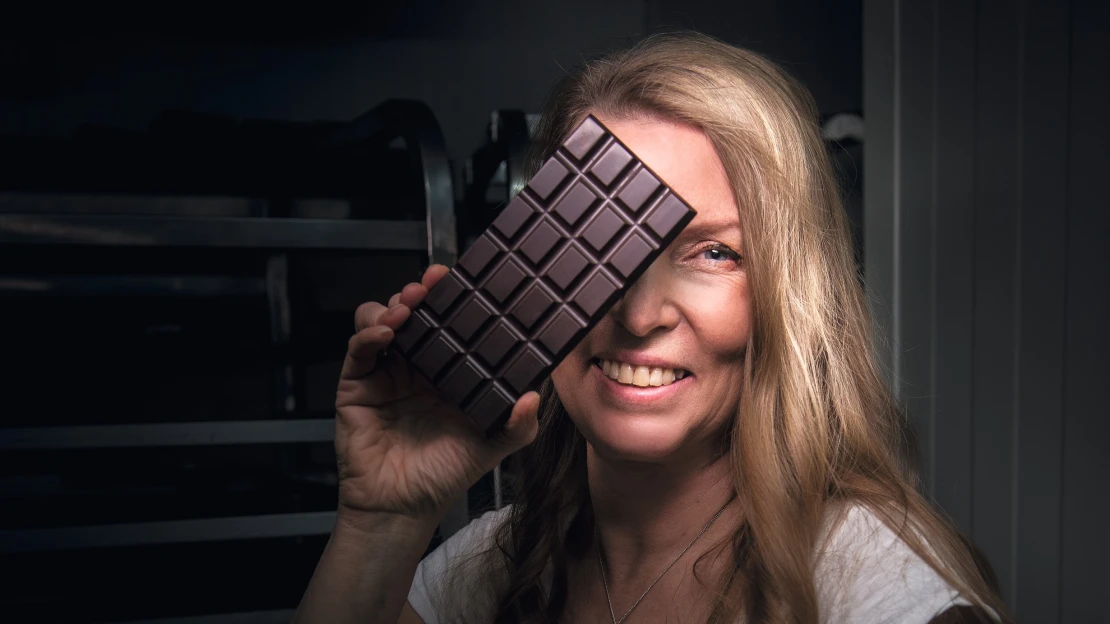
Michaela Dohnálková produces some of the best chocolates in the Czech Republic under the Míšina čokoláda brand. They are bean to bar, single origin, and also highly addictive. So a slight warning: Do not start reading without having at least a piece of your favorite kind at hand.
“I’ve loved chocolate for as long as I can remember. But the breakthrough in discovering it came when my family and I lived in Ireland for several years and I tasted chocolate made from cocoa beans for the first time. When you suddenly sense nuts, fruit or floral notes instead of the sweet taste of sugar, you experience something completely new and there is no turning back for you,” says the founder and owner of Míšina čokoláda, while she plunges her hand into a jute bag full of raw cocoa beans from the Solomon Islands to demonstrate that they look and smell completely different from those from Tanzania or Vietnam.
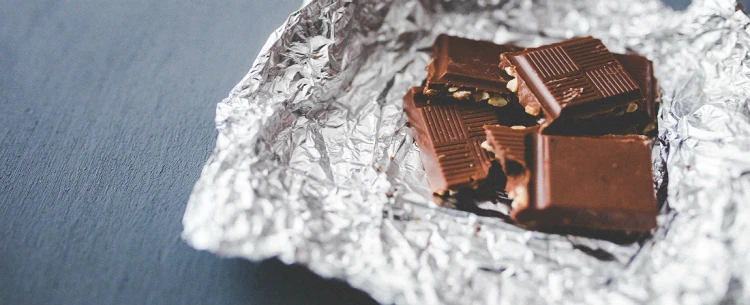 As of this September, all of Míša's chocolates are produced here, in a small facility in Lahovice on the outskirts of Prague, where you probably wouldn't expect to find an internationally award-winning chocolate manufactory. It was here that Michaela Dohnálková moved her business this year from its original location in the basement of her own home, where production had been running since 2015 when Michaela began her first experiments with the fragrant raw material.
Although this year brought difficulties for many entrepreneurs and few would dare such a move and investment, Michaela had known for a long time that she urgently needed more space and better facilities. “That’s exactly how it goes in life. You look for spaces for a year and a half and then you find them at a time like this. And you know that if you don't take the offer, who knows when you will find a similar opportunity,” she just shrugs.
In the small, exclusively female manufactory, 1,500 to 2,000 bars are currently produced per month and their production resembles a proper chocolate laboratory. Everything here shines with hygienic cleanliness and they won't let you inside without shoe covers and hair covers, but the omnipresent intoxicating scent of cocoa won't let your nose rest.
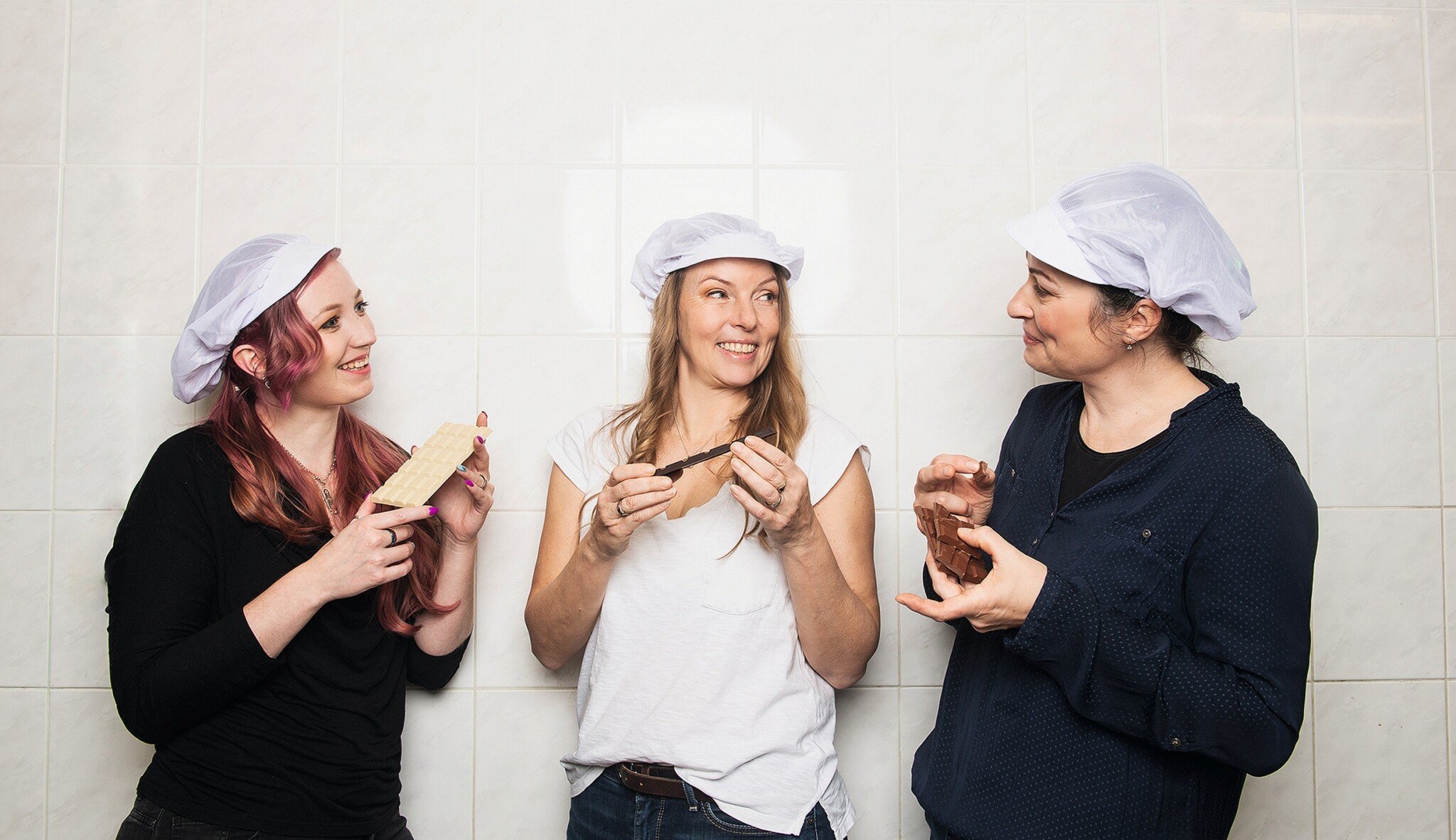

While machines take care of the bean roasting, cleaning or crushing processes, everything is under the control of three sets of eyes and hands – Johana Mirová and Milena Pazderová have been working part-time for several years with Michaela, who is the sole owner of the Míšina čokoláda brand. Both take care mainly of production, while the company's founder has partially shifted towards administration over the years, but when it comes to ideas for what novelty to bring in the future, a three-headed brainstorming session takes place here.
“As far as I know, we are the only chocolate manufactory in the Czech Republic where only women work; otherwise chocolate is more of a male domain here, maybe also because a bag of cocoa beans can weigh well over 60 kilos and it's not easy to wrestle with,” says Michaela with a smile, who herself was among the very first chocolate makers in the Czech Republic five years ago producing chocolate using the “bean to bar” method, i.e., from beans to bar. Although their number has increased somewhat in our country in recent years, you still won't find many similar manufactories here. And you can still count on one hand today those who have raised their fragrant product to a top-tier level.
At the beginning, she toyed with the idea of making pralines, but she knew that she would still want to create them from her own chocolate, so she finally decided on chocolate bars. It took almost a year before she fine-tuned it to be exactly as she dreamed. “That first year was trial and error, a lot of testing. But it's good, at least I got to know perfectly how to work with it truly from the beans to the bar,” laughs Michaela, whose chocolates have one more not entirely common property – each of them is single origin, i.e., created from only one type of bean.
In 2016, the starting entrepreneur, who studied Czech and English studies, worked for many years as a teacher and at the same time spent time at home with her three children, dared to offer her products for sale and was a little surprised that few people here knew bean to bar chocolate. Things moved forward just a year later when she sent one of her bars to the Academy Chocolate Awards competition and won a silver medal for it.
That was the first sign that encouraged her that she was on the right track, and in the following years she paved it with a nice series of bronze, silver and especially gold medals. To date, the chocolate maker has won 34 awards from several international competitions, which is unique within the Czech Republic.
“But beware, it's not like when you get silver at a world competition, you have the second best chocolate in the world. There can be more award winners if they reach a certain score. On the other hand, if the chocolates competing in some year did not meet the specified criteria, it may happen that no one wins gold, for example. So such an award rather shows that your chocolate meets high standards and succeeded among thousands of entries,” she says proudly.
She is most proud of the gold obtained for her chocolate from Vietnamese beans from 2018 (by the way, beans from Vietnam are said to be the fruitiest of all), this year's gold medal for 100% chocolate from Tanzanian beans, which received the highest award in the category of high-percentage dark chocolates as the only one in the world, and then also several Great Taste awards, where in addition to the Great Taste label itself, she won three stars, which is the highest possible number in the quality rating. “This competition is such a chocolate Michelin. When you have one star, it can be compared to Bib, when you have three, you are already a Michelin producer.” 
From Míša's chocolate factory, white, milk and dark (beware, it is forbidden to say bitter!) bars now travel into the world, plain and with various decorations, with different cocoa percentages up to the peak 100%, which have been gaining more and more popularity lately. In addition to permanent flavors, limited editions are also created here, such as “Velvet”, devised for the anniversary of the velvet revolution, in which the base of dark Tanzanian chocolate is complemented by white with rose hips, but also seasonal editions, currently for example Christmas white with cardamom, smelling festively of gingerbread.
Last year, the company's turnover exceeded one million crowns for the first time, but the coronavirus crisis slowed its sales a little, mainly among corporate clients, who have been looking for Míšina čokoláda for a long time for the production of luxury gifts for their clients or business partners, but this year, with the ban on parties, they started to save more in this area.
At the same time, Michaela Dohnálková admits that this year's situation at least prompted her to complete her e-shop more quickly, which quickly increased her sales, and also to speed up the long-planned redesign of her products, literally from bar to packaging. In cooperation with the Calico graphic studio, she is now working on an entire new “suit” for the chocolate: logo, packaging, and even her own mold into which individual pieces will be cast. Míša's chocolates were originally supposed to get a new image already in the autumn, but due to delays caused by the coronavirus, it now looks more like Christmas.
In addition to the new mold, the chocolate will also have a new size – from 80 grams, the bar will shrink to 50. “From the beginning I produced eighty-gram packages, but over the years it turned out that it is not completely functional,” admits the businesswoman. “The vast majority of chocolates of the same quality are produced in fifty- or even just forty-gram packages and their lower price corresponds to that. But many customers do not notice it and think that our chocolate is more expensive, even if it is not true. It costs more just because it is simply bigger.”
Michaela believes that the new business approach, along with her unchanged obsession with quality, will help get Míšina čokoláda to an even wider audience. And she adds that Czechs still need to be taught about super-quality chocolate, the production of which takes easily a week and in which there is a huge share of manual work. “Unlike abroad, Czechs still perceive chocolate primarily as a candy. But the truly good one offers much more and the price corresponds to that,” she convinces. “It's very similar to quality whisky, wine or even coffee. When you work your way up to a certain level, you don't want to go back.”
The article was published in Forbes Woman magazine, autumn 2020 issue.